

Does a social life protect your brain?
What the US Surgeon General found about loneliness and thinking, what a trial of regular video chats showed, and easy ways to stay in touch.
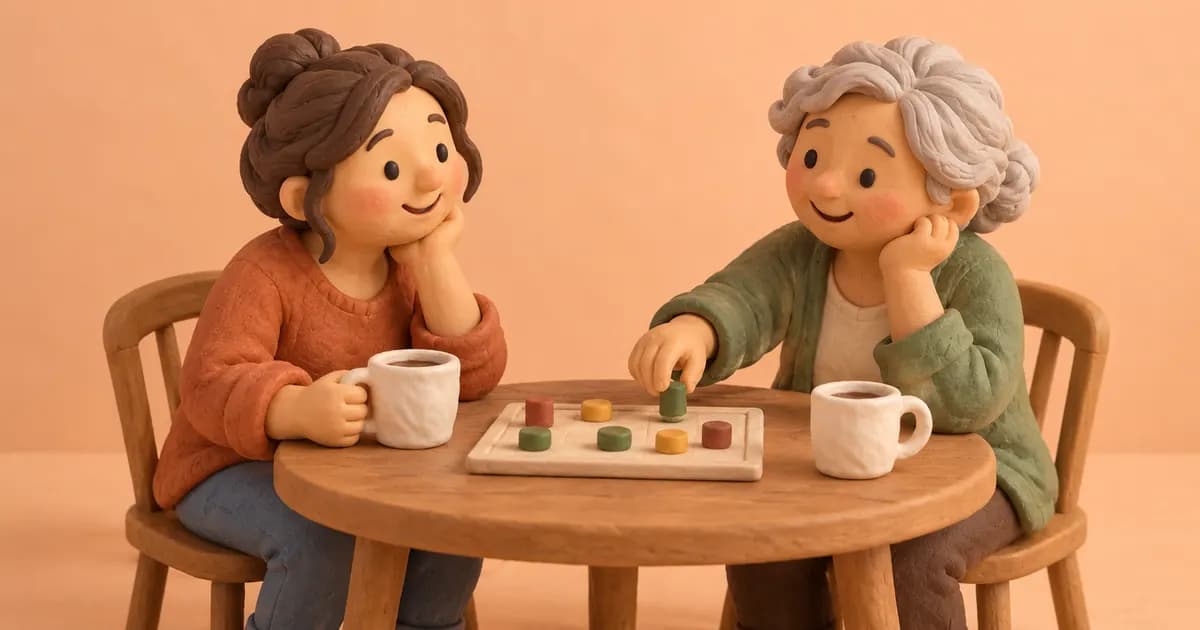
Nobody can promise that it does, but the link is real. Older adults who are isolated or lonely tend to lose thinking skills faster and are more likely to develop dementia. When one trial gave isolated people over 75 regular video chats, those with mild memory problems did a little better on a thinking test. The World Health Organization now recommends social activities, and time with people is worth having anyway.
Does loneliness affect memory and thinking?
In 2023 the US Surgeon General published an advisory on loneliness and isolation. It says there is substantial evidence linking both to faster decline in thinking and a higher risk of dementia in older adults. People with wider circles and more frequent contact tend to have better thinking skills.
That is an association: the two tend to go together. It does not show that adding visits will change one person's risk.
The advisory also separates two things that are easy to mix up. Isolation is something you could count: few relationships, few groups, not much contact. Loneliness is a feeling: the distress of having less connection than you want. Someone with a full diary can feel lonely, and someone who lives quietly may not.
It looks at connection from three sides. How many people you see, and how often. Whether you can rely on them when you need help. And whether time together actually feels good. A count of visits covers only the first.
So if you are thinking about a parent, ask two questions rather than one. How often do they see people? And how do they feel about it?
What happened when isolated people got regular video chats?
A trial called I-CONECT put the idea to a test. It recruited 186 people aged 75 or older who were socially isolated but did not have dementia. Some had normal memory and thinking. Others had mild cognitive impairment, which means more memory or thinking trouble than is usual for their age while still managing everyday life.
About half were picked at random for 30-minute video conversations with trained staff. These ran four days a week for six months, then twice a week for six more. Both groups also got a 10-minute phone check-in once a week.
The pandemic cut the main six-month comparison to 56 people. Among those with mild cognitive impairment, the conversation group scored 1.75 points higher than the others on a 30-point thinking test. Among those with normal thinking, there was no real difference on that test. They did better on a word task, but that was a side measure the authors treat with more caution.
Read it as encouraging but small. The final comparison involved few people, and the volunteers were not very diverse. The trial measured test scores, not who went on to develop dementia. And it tested long, frequent conversations with trained staff, so it cannot tell you what an ordinary weekly phone call does.
Should you make a point of seeing people?
Yes, says the World Health Organization. Its guidance of July 2026 lists social isolation among the risk factors for dementia that can be changed. It recommends social activities for adults whose memory and thinking are normal or only mildly affected. Seeing people sits alongside five other everyday habits in that advice.
How can you stay connected?
Cleveland Clinic's suggestions are refreshingly ordinary: lunch with a friend, a club or group, even a pet. A few ways to make that easier to keep up:
- Put it in the diary. A call at the same time each week is easier to keep than "we must catch up soon".
- Join something you already like. A walking group, a choir, a book club or an evening class gives you people and a reason to go back.
- Set up video calls for a parent who lives far away, and sit with them for the first few until it feels easy.
- Ask what they would enjoy. Some people would rather have one good friend nearby than a busy calendar.
Any of these counts. Start with the one you would look forward to.
Sources
- Our Epidemic of Loneliness and Isolation, advisory — US Surgeon General (2023)
- I-CONECT: Topline Results — Dodge and colleagues, The Gerontologist (2023)
- What Is Mild Cognitive Impairment? — US National Institute on Aging
- New WHO guidelines on dementia risk, news release — World Health Organization (2026)
- 6 Ways To Improve Your Brain Health — Cleveland Clinic (2025)
Related articles

For families
Does what you eat change your memory?
What a three-year trial of the MIND diet found, what the WHO says about vitamin pills, and the simple foods worth building meals around.
Read article
For families
How the AAP's family media plan starts a conversation
What the AAP's 2024 paper says about its Family Media Plan, with questions families can discuss and clear limits on the evidence.
Read article