Holdback
Pass the crates whose mark matches today’s mark, and let the odd ones roll by.
About this game
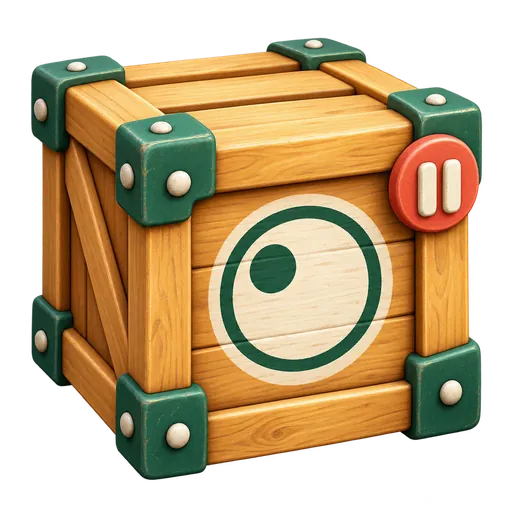
Holdback is a focus game set at a loading checkpoint. Today’s mark sits above the gate, and crates arrive one after another, each with a mark of its own. When a crate’s mark matches, you press Pass crate. When it doesn’t, you do nothing and let it go.
Most crates match, so pressing soon becomes a habit, and that is the catch. The odd crate looks almost the same, with its dot in a slightly different spot. The game asks you to stop the habit for long enough to look.
How to play
- Look at today’s mark above the checkpoint, including where its dot sits.
- When a crate with the same mark arrives, press Pass crate or Space.
- When the dot is in a different place, leave the button alone. The crate moves on by itself.
- Check the feedback: a tick means you passed a match or held back; a cross means a wrong pass or a miss.
Tips
- Check where the dot sits inside the outline, not just the outline.
- Judge each crate on its own. A run of matches doesn’t mean the next one matches too.
- Keep a finger ready, but press only after you have compared the two marks.
How it adapts
As you pass the right crates and hold back on the odd ones, the time to press shrinks and the dot on an odd crate creeps closer to the right spot. A mistake eases things off. Your first run is shorter, with more time for each crate.
Questions
What counts as a right answer?
Passing a crate whose mark matches, and leaving a crate whose mark doesn’t. Doing nothing on an odd crate is a right answer, even though you press nothing.
Can I just pass all the crates?
You would pass the matches, but the odd crates too, and those wrong passes pull your score down and keep the level low. Waiting on all of them fails the other way: you miss the matches.
Is Holdback timed?
Yes. Each crate gives you a short moment to pass it before it moves on. Use the whole moment if you need it: a fast press earns nothing extra.
The research behind it
Holdback is what psychologists call a go/no-go task: act on one kind of item, hold back on another. Researchers use it to study how people stop an action that has become automatic. That moment is what the game is built around: the odd crate that turns up just as your finger is ready.