

Is hearing loss bad for your memory, and do hearing aids help?
Hearing loss and dementia are linked. What a large trial of hearing aids found about thinking, what the 48% headline means, and when to get checked.
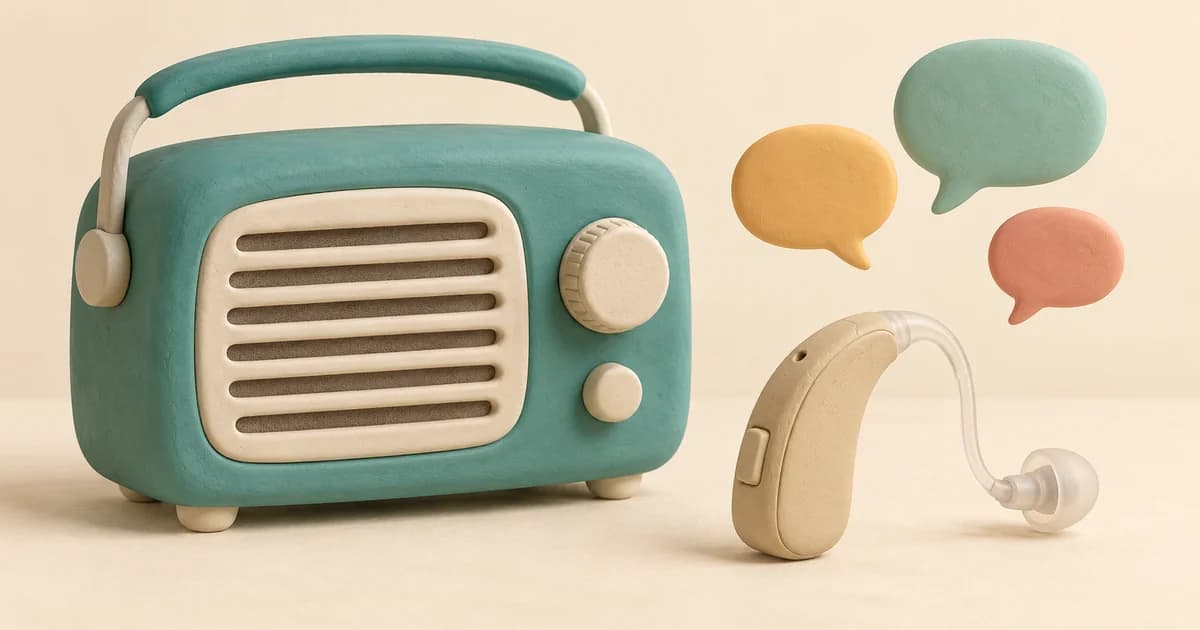
If a parent keeps turning the TV up, or you have caught yourself doing it, you may wonder what it means for memory. Hearing loss and dementia do tend to go together, though why is still unclear. In a three-year trial of nearly 1,000 older adults called ACHIEVE, hearing aids made no difference to thinking skills overall, and appeared to slow decline only in a smaller group at higher risk. By people's own ratings, they did ease the toll hearing loss took on daily life. If the signs are there, a hearing check is the place to start.
How are hearing and memory connected?
Hearing loss is common: about a third of older adults have it, according to the US National Institute on Aging. A 2025 review in the Journal of Neurology concluded that the nature of its link with dementia "remains unclear and is likely to be complex". Hearing loss might help cause the brain changes behind dementia, speed them up, or be one of their results.
Telling those apart takes a trial that gives hearing aids to some people and not to others, then compares what happens.
What did the ACHIEVE trial test?
ACHIEVE was, as far as its investigators know, the first randomised trial of its kind in older adults without memory problems. It recruited 977 people aged 70 to 84 at four sites in the US. All had hearing loss they weren't treating, and none had substantial problems with memory or thinking.
Half, picked at random, were fitted with hearing aids and had four one-hour sessions with an audiologist. The other half met a health educator for sessions on preventing long-term illness. Both groups took a full set of memory and thinking tests over three years. The results were published in The Lancet in 2023.
What did it find?
Overall, no difference. After three years, scores in both groups had slipped by almost exactly the same amount.
Where does the "nearly 50%" headline come from?
The volunteers came from two places. Of the 977, 238 were already taking part in a long-running study of heart health. They were older, had more risk factors for decline and started with lower scores. The other 739 were healthy volunteers from local communities, newly recruited to the study.
In the smaller, higher-risk group, the people given hearing aids lost 48% less ground on the thinking tests over three years than those given health education. Among the newly recruited volunteers, there was no clear difference. Their scores did fall over the three years, at what the authors call a slow rate, and they suggest a "healthy volunteer effect": people who sign up for a study like this tend to be a healthier group. The team is following these volunteers for longer.
Three things are worth knowing before you lean on the 48%. It measures how much a test score changed, not how many people developed dementia. It comes from 238 people, with a wide margin of uncertainty. And it was a planned extra analysis alongside a main result that showed no effect. The authors' own conclusion is that hearing aids "might" reduce decline over three years in older adults at higher risk, but not in those at lower risk.
Did hearing aids help in other ways?
Yes, on how hearing loss affected people's lives. The trial used a short questionnaire on the emotional and social effects of hearing loss. At the start, about 70% of the volunteers scored at a level that signals at least a mild hearing handicap. Six months later, 22% of the hearing-aid group still did, against 65% of the comparison group. The hearing-aid group stayed ahead for the full three years.
People rated this themselves and knew which group they were in, which can colour answers. Even so, it is a large gap.
What do health bodies advise?
The World Health Organization's 2026 guidance on lowering dementia risk says hearing aids "may be offered as part of risk-reduction strategies". Hearing is one part of a bigger picture: the six pillars of brain health covers moving, sleep, seeing people and the rest.
On hearing itself, the advice is simpler. The National Institute on Aging lists the signs that are worth acting on:
- needing the TV so loud that others complain
- often asking people to repeat themselves
- struggling to follow a conversation when two or more people are talking
- having trouble hearing over background noise, or on the phone
- feeling that other people mumble
- finding children's and other higher-pitched voices hard to understand
It calls seeking professional advice the most important thing you can do. Start with your doctor, who may refer you to an ear, nose and throat specialist or an audiologist.
Hearing that goes suddenly, in one or both ears, is different. The NHS says to get an urgent appointment.
Sources
- Hearing intervention versus health education control to reduce cognitive decline in older adults with hearing loss (ACHIEVE), a randomised controlled trial — ACHIEVE Collaborative Research Group, The Lancet (2023)
- Hearing intervention and self-reported hearing handicap in the ACHIEVE trial — Sanchez and colleagues, Journal of the American Geriatrics Society (2024)
- Hearing impairment and dementia: cause, catalyst or consequence? — Levett and colleagues, Journal of Neurology (2025)
- New WHO guidelines on dementia risk, news release — World Health Organization (2026)
- Hearing Loss: A Common Problem for Older Adults — US National Institute on Aging
- Hearing loss — NHS (2025)
Related articles
For families
Does poor sleep hurt your memory?
Short sleep is linked to dementia in big studies, but which comes first? What the research shows, what a sleep trial found, and when to see a doctor.
Read article
For families
What should a family gaming agreement cover?
Where, when, which games, who to chat with and what to spend: what goes in a family gaming agreement, how to write it together, and when to revisit it.
Read article