

What should a family gaming agreement cover?
Where, when, which games, who to chat with and what to spend: what goes in a family gaming agreement, how to write it together, and when to revisit it.
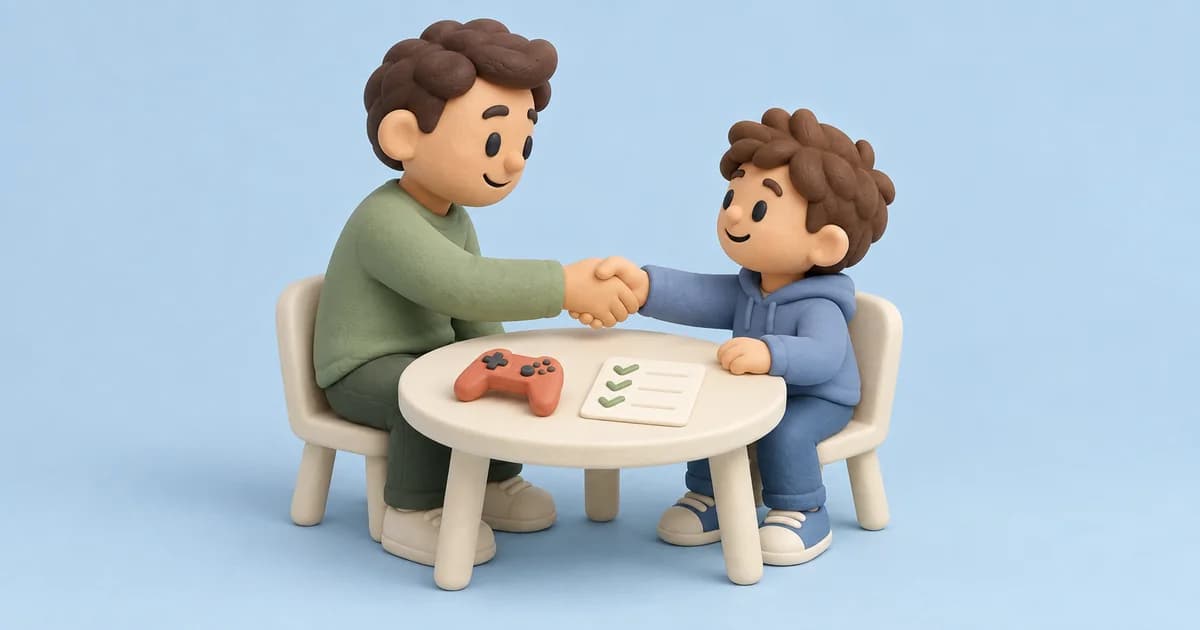
Agree five things: where your child plays, when, which games, who they can talk to, and what they can spend, if anything. Add one promise: if something goes wrong in a game, your child can come to you for help. Write it down together, and look at it again as your child grows. That is the approach behind the family tech agreement from Australia's online safety regulator, the eSafety Commissioner, and the American Academy of Pediatrics (AAP) gives much the same advice.
What goes in it?
1. Where they play
- Shared spaces in the home for younger children, rather than the bedroom. The AAP also advises common areas, though it notes this gets harder as children get older.
2. When they play
- What has to be done first, such as homework or chores.
- No gaming in the hour before sleep, and no device during the night.
- Screen-free times and places, such as the dinner table and homework time.
- How much: neither eSafety nor the AAP sets a daily number of hours for school-age children. The AAP's advice is to put time limits on gaming so it doesn't crowd out homework, exercise or sleep.
3. Which games
- Check the age rating and an independent review before you say yes to a new game.
- Take care with free games: eSafety warns that they often include ads, hidden costs and features that may make it difficult to stop playing.
- Some games take the next two decisions off the table; freegama's brain games, for example, have no chat between players and nothing to buy inside the games.
4. Who they talk to
- Only people you both know and trust.
- Private messages and gifts turned off, or set to friends only.
- The six warning signs eSafety lists: someone who gets friendly very quickly, asks for private information, sends valuable gifts or game items, asks them to keep a secret, wants to move to a more private app with video chat, or asks for sexual content.
- How to turn off chat, mute and report: our checklist for any game site walks you through finding them.
5. What they spend
- Firm limits on the types of purchases, the amounts and how often.
- Parental controls that manage or block spending, and a pre-approved amount or gift card so your payment details stay separate from the game.
- Two age lines from Australian guidance: games with in-game purchases linked to chance, such as loot boxes, are not recommended for under-15s, and games that imitate gambling are not recommended for under-18s, whether or not real money is used.
How do you write it with your child?
Involve everyone in the family, adults included. Pick a time and place where your child feels comfortable, show real interest in what they play, and listen without judgement. eSafety's reasoning is simple: young people are more likely to respond to rules they have helped make and see as fair and consistent.
When you choose parental controls, explain which ones and why, and sit with your child when they set up a new game account. Once it is written, share the agreement with grandparents and babysitters so the rules are the same wherever your child plays.
eSafety's free family tech agreement templates come in versions by age, including 5 to 8, 9 to 12 and 13 to 15, each with example statements and space for your own rules. For screens in general, the AAP's Family Media Plan works the same way.
When should you look at it again?
Whenever your child gets older, gains more independence, or starts a new game, app or device. The AAP suggests the start of the school year and the summer and holiday breaks as natural moments. For teenagers, eSafety describes the agreement as a living document that changes as they take on more independence.
What if gaming is becoming a problem?
An agreement can't fix everything. The AAP's warning signs of unhealthy gaming are a child who:
- is obsessed with gaming, and sad, irritable or anxious when it's taken away
- wants more and more gaming and can't cut down or quit
- is no longer interested in other things they used to enjoy
- lies about how much time they spend gaming
- uses gaming to relieve a bad mood
Sources
- Family tech agreements — Australia's eSafety Commissioner
- How to choose safe games for your kids — Australia's eSafety Commissioner
- How to manage money in games — Australia's eSafety Commissioner
- Playing games with others — Australia's eSafety Commissioner
- How to Make a Family Media Use Plan — American Academy of Pediatrics (2026)
- Unhealthy Video Gaming: What Parents Can Do to Prevent It — American Academy of Pediatrics (2025)
Related articles

For families
Is hearing loss bad for your memory, and do hearing aids help?
Hearing loss and dementia are linked. What a large trial of hearing aids found about thinking, what the 48% headline means, and when to get checked.
Read article
For families
Does poor sleep hurt your memory?
Short sleep is linked to dementia in big studies, but which comes first? What the research shows, what a sleep trial found, and when to see a doctor.
Read article