

Logic & reasoning
How to solve a pattern grid puzzle
Learn to solve a small pattern grid by checking one feature at a time, then use the same method in Potting Tray.
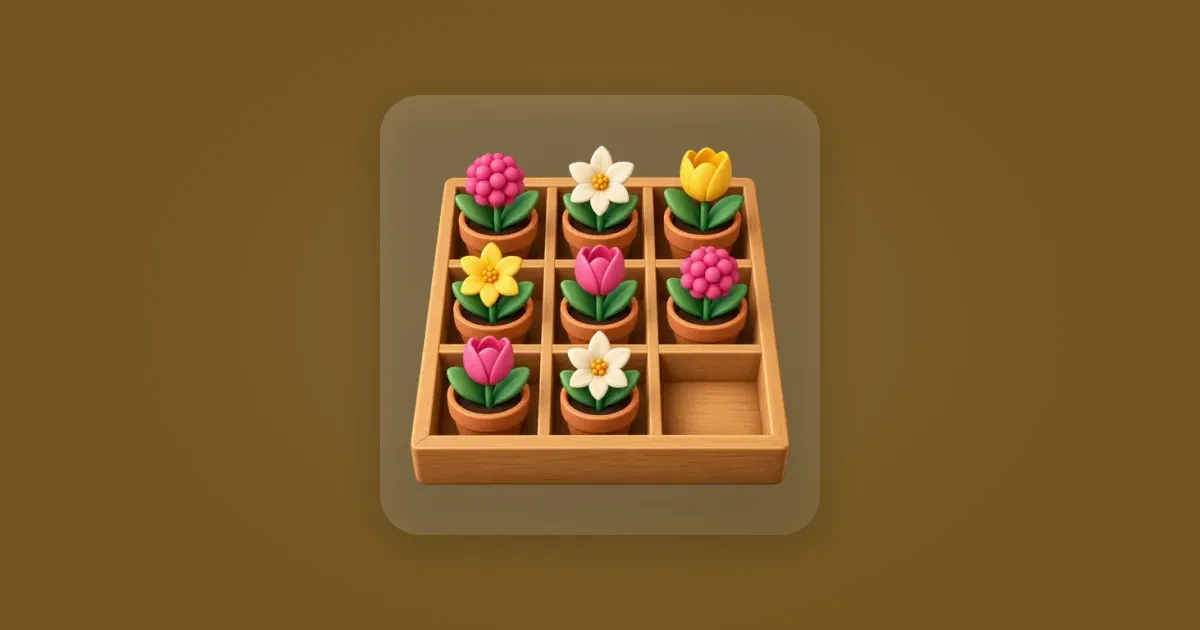
A pattern grid asks you to work out what belongs in an empty space. The grid may contain shapes, colours, numbers or pictures. Each row and column gives you clues. You find a rule that fits the visible spaces, then check whether your answer also fits the other direction.
Researchers use matrix completion tasks to study how people solve this kind of visual problem. In one eye-tracking study of 6-year-olds, 9-year-olds and adults, people who scanned across the rows and columns generally did better on the tasks. The researchers observed a link between looking patterns and results; they did not test whether practising a game improves reasoning elsewhere (Niebaum and Munakata, 2023).
You do not need a special trick to begin. Write down what changes, look for what is missing, and check your answer twice.
Try this three-by-three grid
Each cell below has a flower shape and a colour. In this example, every row and column must contain one daisy, one tulip and one bell. Each must also contain one red, one blue and one green flower.
| Column 1 | Column 2 | Column 3 | |
|---|---|---|---|
| Row 1 | Red daisy | Blue tulip | Green bell |
| Row 2 | Green tulip | Red bell | Blue daisy |
| Row 3 | Blue bell | Green daisy | ? |
Cover the final cell with your hand if you want to solve it before reading on. Start with shape. Row 3 already has a bell and a daisy, so the missing shape is a tulip. Now check column 3. It has a bell and a daisy too. A tulip fits both directions.
Next, ignore shape and look only at colour. Row 3 has blue and green, so it needs red. Column 3 has green and blue, so red fits there as well. The missing flower is a red tulip.
This is a small example of a Latin square: each symbol appears once per row and column. Here, shape and colour each follow that rule. Cambridge's NRICH project gives examples with symbols and coloured discs. The useful question is: which value has this row or column already used? (Beardon, 2011).
Follow one feature at a time
The flower grid has two kinds of information in every cell. Looking at both at once can make an obvious gap feel hidden. Say the shapes in the last row aloud: “bell, daisy, missing.” Then say the colours: “blue, green, missing.” You have turned one crowded picture into two short checks.
On paper, you can make a tiny note beside the blank: “shape = tulip; colour = red.” If the grid also uses size or a number of leaves, add a third line. A note is especially helpful when one feature is solved before another. You can come back to it without trying to hold every clue in mind.
The Institute of Education Sciences recommends visual representations and reflection on the steps used to solve maths problems in grades 4 through 8. That guidance covers classroom maths, not this flower puzzle. Here, the practical idea is simple: make your candidate answer visible and check the steps that led to it (IES, 2012).
Check the row, then the column
Sometimes one direction gives you a quick answer. Do not stop there. The crossing direction is a second test. If a colour appears twice in the row after you fill the blank, try another colour. If it works in the row but repeats in the column, the guess fails.
This matters when a puzzle has several features. You might correctly choose the shape and then choose a colour that looks attractive with it. The colour still has to obey its own rule. The same applies to a leaf count: a flower with the right shape and colour can still be the wrong answer if its leaves repeat a number already present.
When a grid seems inconsistent, check what its instructions actually say. Some puzzles use “one of each” in every row and column. Others use a growing number, a rotation or a different relation. Do not impose the flower rule on every grid. First state the rule you think you see, then test it on a row or column with no blank. If it fails there, it cannot explain the missing cell.
The eye-tracking study found that scanning rows and columns was associated with better matrix-task performance across its age groups. It also found that looking at possible answers early and often went with poorer performance. That does not turn “never look at the choices” into a rule. It suggests a useful order to try: inspect the grid first, form a candidate, then use the choices to check it (Niebaum and Munakata, 2023).
Make a small puzzle of your own
Draw three rows and three columns. Choose three shapes and three colours. Place each shape once per row and column, then do the same for the colours. Erase one cell and ask someone else to fill it. Check their answer against both directions. If they give a different answer that also fits, inspect your rules and clues together.
Making the grid can help you see why a fair puzzle needs enough information. A single row may leave choices open. A crossing column can narrow them. If several answers still satisfy every stated rule, the puzzle needs another clue rather than a more confident guess.
What Potting Tray asks you to do
In Potting Tray, you fill an empty pot in a three-by-three flower tray. Every row and column uses each active flower shape once. At higher levels, colour and then leaf count also change. You choose the missing features using dials and submit your flower. The game shows which features were right and reveals the answer when needed.
Try the same order as the worked grid: shape first, then colour, then leaves when that rule is active. A later level may offer more possible values than appear in the grid. Use the visible row and column to identify the three values in play. The score uses your accuracy and the level you reached on Potting Tray's own puzzles. If it rises over time, you have evidence of progress in this game. It does not show a general change in reasoning outside it.
Sources
- The Development of Relational Reasoning: An Eyetracking Analysis of Strategy Use and Adaptation in Children and Adults Performing Matrix Completion — Niebaum and Munakata (2023, Open Mind): row-and-column scanning in matrix tasks
- Latin Squares — Toni Beardon, University of Cambridge NRICH (2011): each symbol occurs once per row and column
- Improving Mathematical Problem Solving in Grades 4 Through 8 — Institute of Education Sciences, Woodward and colleagues (2012, revised 2018): visual representations and checking a strategy
Related articles

Logic & reasoning
Skyscraper-style puzzles and step-by-step deduction
Learn how tower sightline clues work, solve a small 4×4 example, and find a clear next move when a grid feels stuck.
Read article
Logic & reasoning
How to spot the rule in a number sequence
A simple method for testing number patterns, explaining your rule and spotting when more than one answer fits.
Read article