

Key Ring
A free deductive reasoning game: arrange coloured keys, read the clue lights after each try, and narrow down the hidden order that opens the lock.
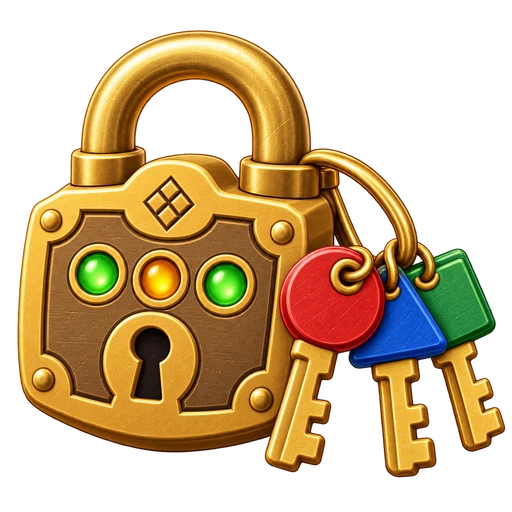
About this game
Key Ring is code breaking from clues. It practises deductive reasoning: using known facts to rule out arrangements that cannot fit. Each attempt supplies counts of correctly placed keys and correct keys in other places. This belongs to the code-breaking puzzle family, studied through logical models of deduction. Diamond places reasoning among higher-order executive functions. The lights constrain your next attempt, but they never label which individual key earned a particular clue.
Opening locks is the measure behind your scores in this game. The result weighs the share opened alongside the difficulty you settle at as the locks adapt. You need the full order within the allowed tries and any deadline; partial matches do not count as an opened lock. Follow progress across runs in the same age band. A higher score means better results on these locks, without establishing broader reasoning ability.
How to play
- Choose a key for every place, then press Try.
- Count green lights for correct keys in correct places, and amber lights for correct keys elsewhere.
- Compare the clue counts with your earlier attempts and change the order.
- Open the lock before the available tries run out.
Tips
- Treat the lights as counts for the whole guess, not labels beneath particular keys.
- An attempt with no green or amber lights rules out every key it contains.
- From level six, consider repeated keys when working out which orders still fit the clues.
How it adapts
Each age band limits how high the level can go, with successful locks moving the challenge upward. The locks gain more places and key choices, allow repeated keys from level six, and introduce deadlines from level four.
Questions
What do the green and amber lights mean?
Green counts a correct key in the correct place. Amber counts a correct key in a different place. Each key occurrence is counted once, so a green match cannot also earn an amber light.
Is this code-breaking game untimed?
The first three levels have no lock deadline. They still limit the number of guesses, so use each clue carefully. Higher levels add time limits. A run can finish between locks before all eight are played.
Can the hidden order repeat a key?
At levels one through five, each key appears at most once. From level six, repeats are allowed. The same key may then belong in several places, and the clue counts still account for each occurrence separately.
The research behind it
Gierasimczuk, van der Maas and Raijmakers studied deduction in code-breaking puzzles with supplied clues. Key Ring instead lets you choose attempts and receive new clues. Diamond supplies the reasoning framework. These sources do not establish benefits beyond this game.
Related games
 What Comes NextFinding how numbers change in a sequence.
 Potting TrayFinding missing features from rows and columns.
 Slide TilesPractise planning your moves ahead.
 Number GridPractise filling a grid so no number repeats.
 Cord GardenPractise planning a route through a grid.
 Bell CovePractise placing one bell in every row, column and cove.