

Slide Tiles
A free visuospatial planning game: slide picture tiles into the empty space, think ahead about the next moves, and rebuild the scene within your move allowance.
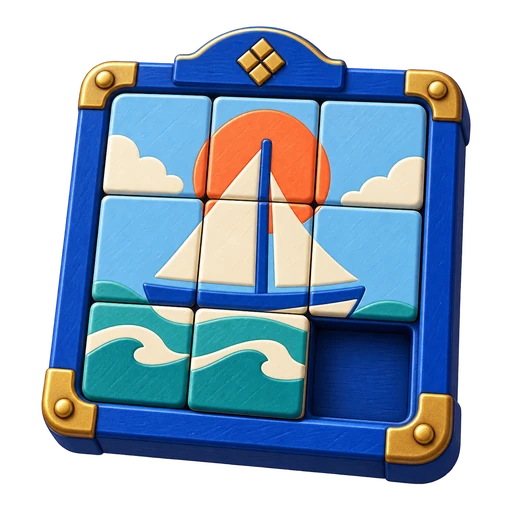
About this game
Slide Tiles practises visuospatial planning: thinking through changes to a picture’s arrangement before making them. It uses the sliding tile puzzle family, with eight tiles on smaller boards and the 15-puzzle form on larger ones. Only a tile beside the empty space can move, so placing one piece changes your options for the next. Diamond’s executive functions framework includes planning among higher-order functions. This game applies that idea to short sequences of legal tile moves.
Your scores in this game reflect the difficulty you settle at and how often you finish a picture. That difficulty adjusts after each board. Completion requires staying within the move allowance and, later, a deadline. Saved moves leave more room to solve the picture but earn no separate points. Use results from your own age band for comparison. The record describes these tile arrangements, without predicting how you plan other tasks.
How to play
- Look at the broken picture and find the empty space.
- Tap a tile directly beside that space to slide it in.
- Plan where the gap will move before choosing the next tile.
- Rebuild the whole picture within the displayed move allowance.
Tips
- Follow picture edges and landmarks to work out which pieces belong together.
- Think about the empty space’s next position, as well as the tile you want to place.
- Avoid sliding a tile back immediately unless that reversal helps a clear plan.
How it adapts
The age bands have different ceilings, and successful pictures raise the level within those limits. Boards grow from three-by-three to four-by-four, need longer solutions, and introduce deadlines at level four; the first three levels have no board deadline.
Questions
What is a sliding tile puzzle?
It is a board with one empty space and pieces that move into it. In Slide Tiles, the pieces form a picture. You can move only adjacent tiles, so reaching one piece often requires moving others first.
Are the pictures always solvable?
Yes. Each board comes with a checked solution and a move allowance above the shortest solution length. A board that seems blocked may need a tile to move away from its final place temporarily.
Can kids play without a countdown?
The first three levels have no board deadline for any age band. The move allowance still applies, so consider each slide. From level four, timed boards begin; Kids profiles can reach these levels too.
The research behind it
O’Hara and Payne studied planning strategies while solving the eight-puzzle. Diamond supplies the broader executive functions framework for planning. These references explain the task family; they do not establish that Slide Tiles changes how you plan outside its boards.
Related games
 What Comes NextFinding how numbers change in a sequence.
 Potting TrayFinding missing features from rows and columns.
 Key RingPractise deducing a hidden order from clues.
 Number GridPractise filling a grid so no number repeats.
 Cord GardenPractise planning a route through a grid.
 Bell CovePractise placing one bell in every row, column and cove.